

Meta Marketing Summit brought together Meta and top EMEA advertisers to share strategy, case studies, and product roadmap updates. The Evido team was on the ground. Here's what actually changes how you work.
Meta now covers the entire customer journey — not just the top of the funnel
Derya Matras, VP EMEA, opened the summit with a number: 3.5 billion people use Meta products daily. But the bigger point was this: Meta has stopped being just an acquisition channel.
According to Kantar (25,000 shoppers, September–October 2025):
- 59% discover new products through Meta
- 53% say Meta ads influenced their purchase decision
- 48% use Meta at the moment of purchase
- 42% interact with brands through Meta post-purchase
If you're only optimizing the bottom of the funnel, you're missing more than half of Meta's actual influence.
Advantage+: a different ROAS on the same budget
Meta shared data from 1M+ campaigns (UC Berkeley methodology, Tadelis et al.):
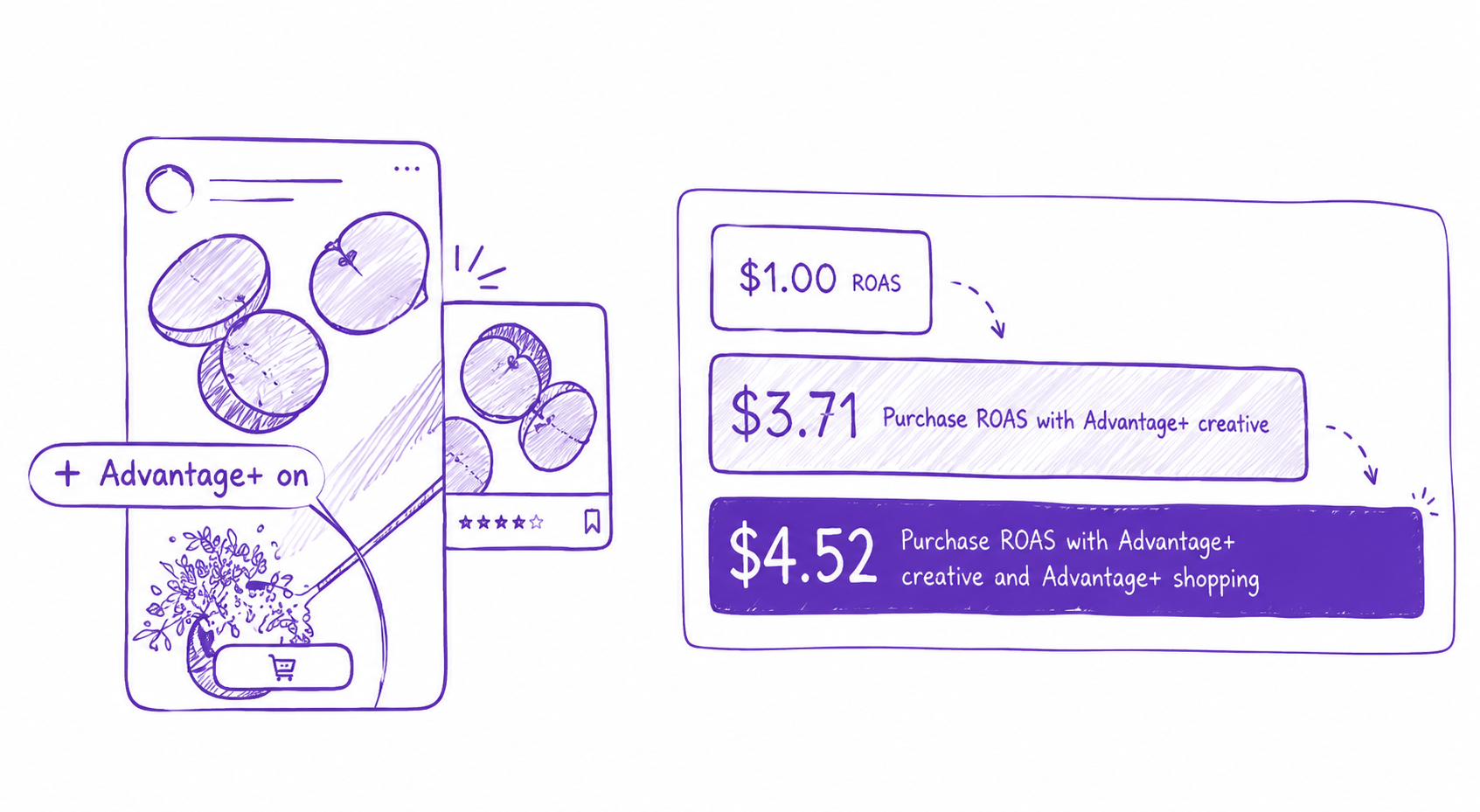
The same budget, meaningfully different outcomes depending on how much automation you use. If Advantage+ Shopping Campaigns aren't in your strategy yet, that's a gap worth closing.
Where are you on the automation curve?
Alexey Bessonov (Meta, Group Director CEE) laid out four stages of performance marketing evolution:
| Stage | Management type | Status |
|---|---|---|
| Stage 01: Manual | Human-led: Manual Execution | LEGACY |
| Stage 02: Streamlined | Human-led: Automated | NOW |
| Stage 03: AI-Enabled | Human-led: AI-assisted | EMERGING |
| Stage 04: Agentic | Agent-led: Autonomous Execution | NEXT |
Half the industry is stuck between Stage 02 and Stage 03. That gap is the biggest competitive opportunity right now — for those who move.
How to build AI-first creative: five principles
The most practical session of the summit. Here's what the market leaders are actually doing.
01. Agentic workflows over manual production. AI handles: insight mining → concept generation → asset production → testing. Humans own: strategic direction and quality control. "Give each creative person 10x the capability."
02. Explore / Optimize / Scale — separately, always. 30% of budget on new concepts, 60% on iterating proven winners, 10% on scaling what's confirmed. Mixing them kills the signal.
03. Sprint velocity over campaign planning. Launch a batch → read signals in 48–72 hours → iterate → retest at least 3 times. "New creatives don't fail. They get abandoned too quickly."
04. System analysis over creative judgment. Track: creative age, diversity scores, fatigue multipliers, format splits. Benchmarks are hypotheses to test, not rules to follow.
05. Diversification over iteration. Not one concept in five hundred variations — five fundamentally different concepts running in parallel. That's how the algorithm finds new audience pools.
Here's how this looks in practice — the AI-first creative flow from Holywater, which produces 30,000 video creatives per month:
.png)
The loop is closed: request → generation → quality check → deploy → get signals → scale via iteration engine. Humans set direction; AI handles velocity.
And here's how to structure creative batches properly:
.png)
Left side — the common mistake: two ad sets, each filled with iterations of the same two ideas. Right side — the right way: each ad set has two variations of five different concepts. The algorithm sees diversity and finds different audiences.
WhatsApp is a sales channel now, not just support
Meta was direct: "Commit 1% of budget to WhatsApp." Solidgate's data shows why:
| Metric | ||
|---|---|---|
| Open rate | 20% | 98% |
| Click-through rate | 8% | 45–60% |
| Cart recovery rate | 3–8% | 12–25% |
| Avg. delivery delay | 2–4 hrs | <1 min |
3–5x more recovered revenue through WhatsApp vs email on abandoned carts. This isn't an experiment — it's working at scale right now.
Nearly 80% of people globally message a business at least once a week. The question isn't whether you need WhatsApp — it's whether you're ready when they message you.
Signal quality beats strategy
One of the sharpest points of the summit came from Inessa Ishunkina (Marketing Science, Meta): "Strategy doesn't work if the signal is weak. Before changing your creative, targeting, or budget — fix your data quality."
Meta's auction formula: Total Bid = Advertiser Bid × eCVR + User Value, where eCVR is the predicted probability of conversion. That's where value information feeds in. If you're sending identical purchase values for every conversion, the model can't tell the difference between a low-value and high-value user.
Two signs of a healthy signal:
- Volume and Velocity — don't fragment your budget; consolidate campaign structure; let campaigns run past the learning phase
- Value Diversity — variety in conversion values you pass to Meta; campaigns with diverse purchase values reach lower CPP
Liven (wellness app) case: after switching to Value optimization with an improved LTV prediction model — +510% LTV compared to volume campaigns.
Meta product roadmap 2026: what's announced and what's coming
2 product sessions at the summit are worth reading together. The first — from Agnieszka Jaworska (PMM EMEA) — covered new tools for app advertiser acquisition and measurement. The second — from Julian Dan (PMM EMEA) — covered how to tell the system what to actually optimize for and which data to trust.
Performance improvements for App Promotion
Right now, App Promotion optimizes mainly for users who take action in the first few days after install. Users with high LTV who convert later get undervalued by the system. Two announcements address this directly:
| Feature | What it does | Status |
|---|---|---|
| AI infrastructure improvements | Better predictions, higher ROAS for prospecting | Ongoing |
| 28-day optimization windows | Optimizes for users who generate value over 28 days, not just the first few | H1–H2 2026 |
| Enhanced target ROAS | More stable, predictable delivery against a set ROAS target | H1–H2 2026 |
Plus a few already-available settings many aren't using:
- Engaged view conversion optimization — optimizing for video views >10s delivers ~13% more attributed installs
- Inactivity window — aligning this with your MMP setting drives ~30% more reactivations in Sales campaigns
- Install state targeting — explicitly target people without the app (prospecting only), with the app (retargeting only), or all
One number to remember: +29% ROAS when switching from volume optimization to "maximize value of conversions," per Meta's internal experiments.
Updated ad formats
.png)
Measure accurately
Meta has reinstated AMM (Advanced Mobile Measurement) — the program giving MMP partners access to last-touch data in unaggregated form. Additionally, AEM data is now available directly through MMP without a separate integration.
The MMP integration list has grown to 7: AppsFlyer, Adjust, Kochava, Branch, Airbridge, Singular, and new — Tenjin. Impact of connecting MMP integration: +8.9% install conversions attributed to Meta by MMP data.
Manage through AI agents
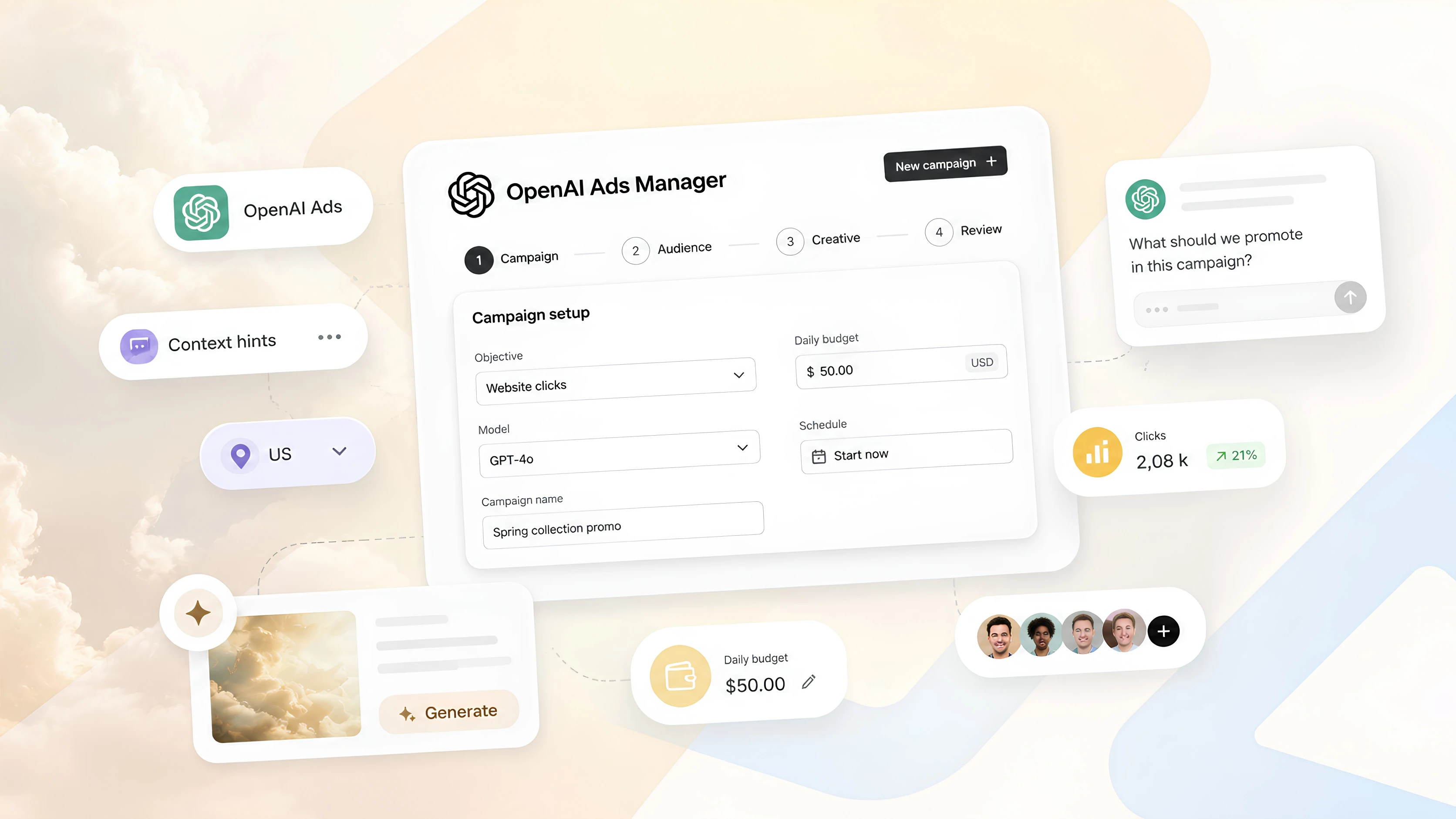
Meta launched an official MCP server: mcp.facebook.com/ads. After authorization, an AI agent gets access to campaign, audience, and catalog data and can manage everything through natural language.
Tell the system what actually matters
Julian Dan (PMM EMEA) laid out three levers that determine what your ads actually optimize for:
.png)
Lever 1 — Value expression: what counts as a valuable result
Most advertisers optimize for a purchase event. The system works more precisely when you give it more context:
| Tool | What it does | Status |
|---|---|---|
| ROAS optimization for conversion events (Purchase & non-purchase) | Optimize ROAS against the value you define | Available |
| ROAS optimization for Profit & pLTV | Optimize for margin or predicted lifetime value | New |
| Customer lifecycle strategy | System prioritizes conversions from the right type of customers — e.g. new only | New (closed beta) |
Lever 2 — Business priorities: balancing volume and value
- Value rules — bid multipliers for priority audience segments (up to 10 rules, up to 2 criteria each). Available.
- Updated ROAS goal — maximize volume and value at a given ROAS target. Headway A/B test: CPA 10–15% lower at the same ROAS. New — Beta for Web.
Lever 3 — Attribution: which source of truth to use
- Incremental attribution — only credits a conversion to an ad when there's evidence of actual incremental effect, not just exposure
.png)
- Custom attribution (Beta) — pass your own attribution data to Meta via CAPI or through Northbeam, Triple Whale, Rockerbox, or Adobe integrations. The system optimizes toward your source of truth, not Meta's own data.
Custom attribution case studies: Laura Geller — +37% ROAS, −17% CPA; OGEE Organics — +213% new customers, +145% new customer ROAS.
What to actually do right now
The summit pointed in one clear direction. Here's a quick checklist:
- Check the age of your active creatives — if it's over 21 days, your "best" ad is just the least fatigued one
- Launch Advantage+ Shopping Campaigns if you haven't yet
- Put 1% of budget into WhatsApp — even just as a test
- Pass different purchase values through CAPI, not a single flat event
- Launch at least one concept that looks nothing like what's currently working — that's your Exploration Engine
If you want to figure out where your specific growth lever is, reach us out in the chat.

.jpg)
.jpg)
_converted.webp)


%20(1).png)

.png)
.png)


.png)