

New advertising channels do not come around often.
Search advertising changed how marketers capture existing demand. Social media changed how they create that demand. Retail media changed how brands buy attention closer to the moment of purchase.
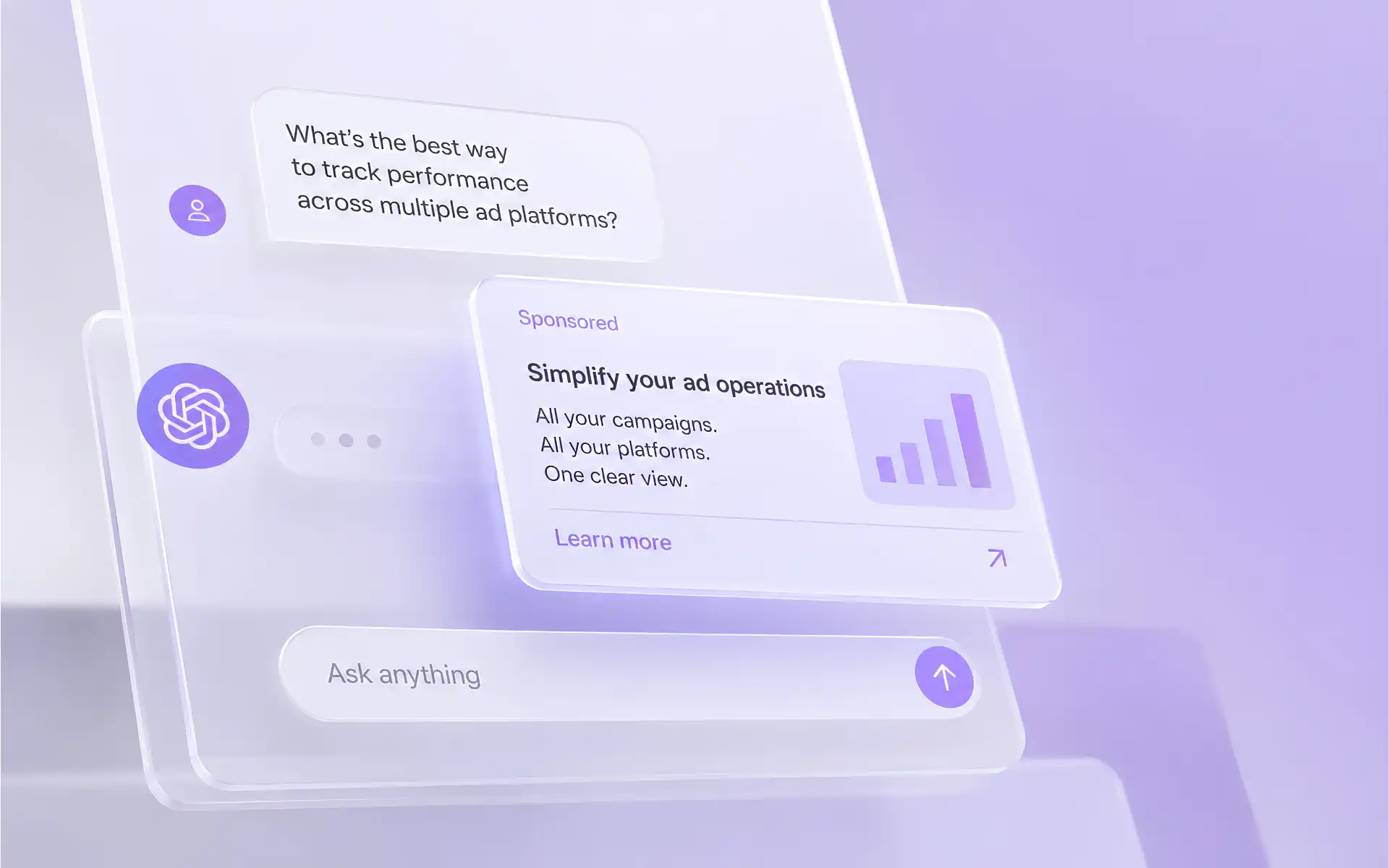
Ads inside ChatGPT work differently.
They do not appear in a feed or next to a search query. They appear inside a conversation, where a person is already defining a task: exploring options, comparing solutions, narrowing the choice, and gradually moving toward a decision.
After a week of working with the beta version of OpenAI's ads dashboard, we have pulled together the main takeaway: what ChatGPT ads actually change for media buyers.
The unit of targeting is the conversation, not the keyword
Search advertising works with queries. Social advertising works with user profiles. ChatGPT advertising works with live conversations.
That matters because people rarely use ChatGPT the same way they use Google.
They do not always write:
"best CRM system"
More often, the request sounds like this:
"I run a small agency and need a simple CRM that won't take weeks to implement. The most important things are tracking client communication, reminders, and deals. Which options should I compare?"
That is a different kind of intent. It is longer, less formal, and often much closer to a real buying decision.
In the beta version of OpenAI's ads dashboard, targeting is not built around keyword lists or predefined interest groups. Instead, you describe the conversations where your ad would be relevant.
OpenAI also describes ChatGPT ads not as placement next to a single search query, but as a chance to appear when someone is exploring options, comparing solutions, and moving toward a decision.
For media buyers, this changes the core skill. The advantage shifts from audience selection to the precise description of intent.
A weak context description would sound like this:
"Show ads to users interested in marketing tools."
A stronger version would be:
"Show ads when a small business owner, marketer, or agency specialist is comparing tools for managing ad campaigns, consolidating reporting, controlling budgets, or simplifying work across multiple advertising platforms."
That looks much more like a brief than a keyword list.
Practical tip: write the context description as if you were giving a task to a smart junior strategist. Specify who the user is, what situation they are in, what problem they are trying to solve, where they are in the decision process, and which alternatives they are comparing.
The strongest early advertisers will build a library of "conversation moments"
In ChatGPT, the most useful question is not only: "Who is this person?"
The more important question is: "What are they trying to understand right now?"
For example, a software company can test separate context descriptions around different situations:
"Someone is comparing tools before making a purchase"
"Someone is looking for a replacement for their current solution"
"Someone is trying to fix a workflow problem"
"Someone is looking for ways to reduce costs"
"Someone is building a shortlist of options for a manager or client"
Each of these situations may call for a different advertising message.
A user asking, "Which tool is the cheapest?" probably should not see the same creative as a user asking, "What should I show the CFO?"
In the first case, the person is price-sensitive. In the second, they need confidence, proof, and language they can use inside the company.
Example from practice
For an advertising platform, one context might be related to budget control:
"I run ads on Meta, TikTok, and Telegram and want to see spend in one place."
Another might be related to entering a new market:
"I want to launch campaigns in a new country, but I do not understand the platform requirements or moderation rules."
The product is the same. The intent is different. That means the ad should be different too.
Practical tip: before writing ad copy, create a simple three-column table: "conversation", "user concern", and "ad promise". If the concern is different, the creative should be different too.
Reach is limited right now, and that is the opportunity
OpenAI says ads are currently shown to users on the Free and Go plans in the United States, Canada, Australia, and New Zealand. They are not shown to Plus, Pro, or Business users, or to users under 18.
That is a limited geography. But the combination of "early" and "not yet mass-market" creates good conditions for learning.
We have also prepared a separate detailed article on how to set up an OpenAI ad account.
Right now, the market has fewer benchmarks, fewer ready-made instructions, and fewer competitors. So the first stage is not really about scale. It is about recognizing patterns.
Media buyers should not enter this channel only asking:
"Can I scale this next week?"
A more useful question is:
"Which types of conversations have commercial value for us, and which messages move people from that context to a click?"
Those learnings will become even more valuable when the platform starts to expand.
Practical tip: do not test ChatGPT advertising with one broad campaign. Instead, build a small test plan by intent group. Even with a modest budget, the important thing is to understand which type of conversation produces a useful signal.
For example:
Campaign: product research before selection
Ad group 1: comparing solutions
Ad group 2: looking for a replacement for the current tool
Ad group 3: request for budget control
Ad group 4: preparing a recommendation for the team
This kind of structure gives you more than clicks. It gives you conclusions you can use later.
The interface is simple, so the real skill moves elsewhere
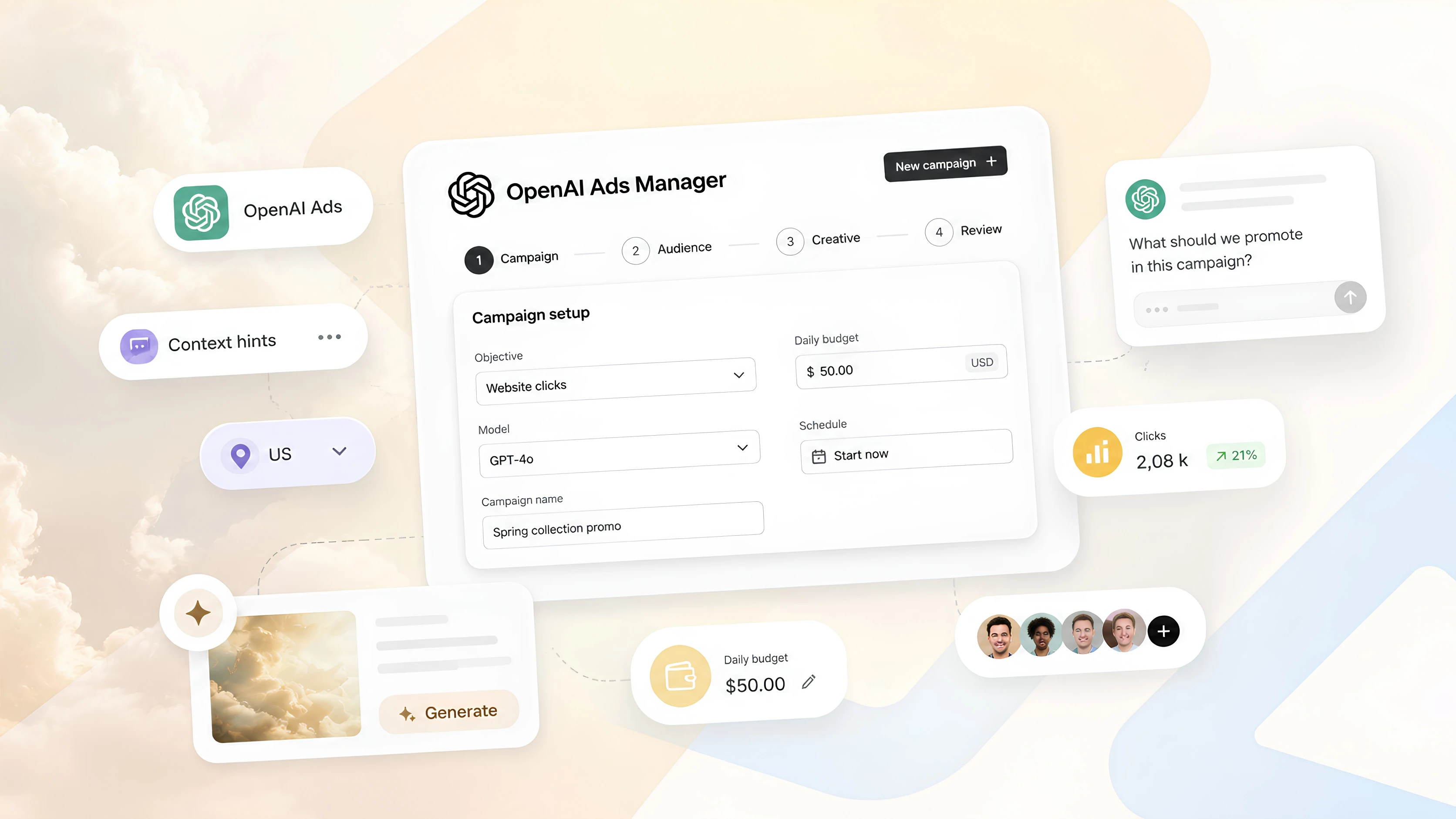
The beta version of OpenAI's ads dashboard is intentionally simple. OpenAI describes it as a platform for creating, launching, and managing ad campaigns, with campaign setup, bulk ad uploads, performance tracking, account settings, and CSV data exports.
That simplicity has two sides.
The good part: fewer operational complications.
The bad part: the interface itself will not become your advantage.
Soon, everyone will understand where to create a campaign, an ad group, and an ad. Everyone will know where to set a budget, upload assets, and check the basic metrics.
The real craft will be in two things:
- How precisely you describe the context
- How relevant the ad feels inside the conversation
This is not the place for generic messages like:
"Grow your business today."
The ad should feel like a useful next step in a conversation the person is already having.
Weak:
"Try our all-in-one marketing platform."
Better:
"Launching ads in a new market? Get ad platform setup, payment support, and campaign management in one place."
Even better:
"Planning TikTok campaigns in a new country? Evido helps with account setup, local requirements, and ad launch."
The more specific the conversation, the more specific the advertising message can be.
Practical tip: write ads as an answer to the user's unfinished thought. The person is already in the middle of choosing. Do not start the conversation from scratch.
Reporting is still at an early stage
The reporting system is still developing. OpenAI says that in the beta version of the ads dashboard, advertisers can track impressions, clicks, and spend at the campaign, ad group, and individual ad level. Data is available in tables, charts, and CSV exports.
OpenAI has also added pay-per-click pricing alongside the earlier CPM model and continues to develop measurement tools as the platform evolves.
This means media buyers should not judge the channel too early by the standards of mature ad platforms.
This is not Meta, with many years of pixel history. And it is not Google Search, with decades of accumulated bidding and behavior data. It is a new advertising surface with a new intent signal.
So the first tests should answer practical questions:
- Which types of conversations generate clicks?
- Which ad messages feel relevant in this environment?
- Which landing pages continue the conversation instead of cutting it off?
- Which offers work when the user is still comparing options?
You should not send everyone to a generic homepage. If the ad appears in a conversation about how to launch TikTok ads in a new market, the landing page should continue that same thought.
Practical tip: create landing pages around the same intent used to trigger the ad. The context description, the ad, and the landing page should all be built around the same user task.
For example:
Context description: the user is comparing ways to launch ads in a new country.
Ad: "Launch campaigns in new markets with local ad platform setup and support."
Landing page: "What to prepare before launching TikTok Ads in a new market."
Call to action: "Check launch requirements."
This path feels much more logical than sending the user to a general services page.
The creative's main job is to build trust
ChatGPT is not a feed where someone is scrolling and might accidentally notice an ad. People come here with a specific question: to understand something, compare options, find a solution, or prepare for a decision.
That is why generic advertising quickly feels out of place. If an ad does not continue the user's train of thought and simply tries to grab attention, it will feel like an interruption.
A strong ChatGPT ad should create the feeling:
"This could help me solve the question I am working through right now."
Not:
"Someone just bought my attention."
The best early creatives will most likely be clear, practical, and easy to act on.
For B2B, calls to action could look like this:
"Check launch availability"
"Compare launch options"
"View platform requirements"
"Assess media buying readiness"
"Confirm market availability"
Not every call to action needs to push immediately to a product demo. In many ChatGPT conversations, the user is still clarifying the task. A softer call to action may fit the decision stage better.
Example from practice
If someone asks how to start advertising on TikTok in Kenya, "Book a demo" may feel too heavy.
"Check what you need to launch TikTok Ads in Kenya" fits the moment better. The commercial intent is still there, but the action feels useful to the user.
Practical tip: test one direct call to action and one decision-support call to action. In this environment, the second option may work better than expected.
What we would do this quarter
If you buy media, we would not wait for perfect benchmarks.
Right now, it is worth doing three things.
First, study the platform while it is still quiet. Run small, structured tests not for scale, but to understand which types of conversations have commercial value.
Second, treat context description as a new media buying skill. Build an internal library of strong formulations by product, vertical, audience pain point, and decision stage. Teams that learn how to describe user intent precisely will move faster when the platform starts to expand.
Third, prepare the post-click journey. Advertising in ChatGPT will quickly expose weak landing pages. If someone arrives from a specific conversation, a generic "our solutions" page will feel disconnected from their task. You need pages that continue the logic of the question.
The early opportunity here is not only cheaper media buying. It is cheaper learning.
Every new advertising surface has a short period when the rules are still being formed. Advertising in ChatGPT is at exactly that point now.
Evido by Aitarget is already working inside the ads dashboard, and we will continue sharing what we learn. If you need a partner that entered this new channel early, or simply want to be notified when your market becomes available, we can help.

.jpg)
_converted.webp)


%20(1).png)
.png)
.png)
.jpg)

.png)